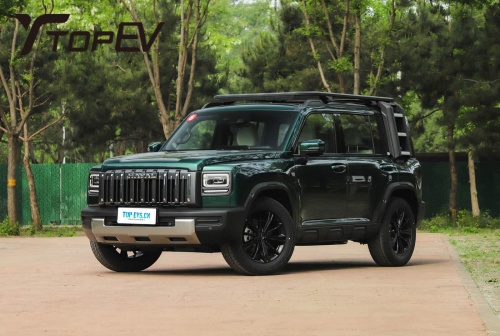
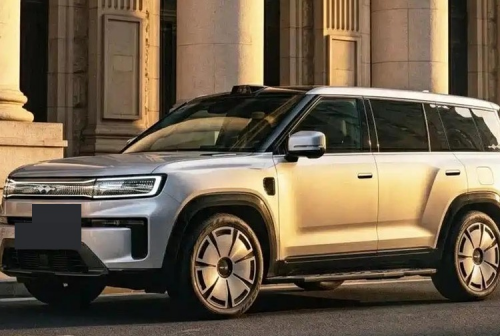
BYD's Fangchengbao sub-brand has spent two years building a reputation for vehicles that look like they belong on a mountain and drive like they belong on a motorway. The Tai 9 is the largest thing to come out of that experiment yet: a 5,270 mm six-seat plug-in hybrid SUV that the brand positions in the 400,000 class and intends to put on sale in China after mid-November.
It is the third model in the Tai line, after the Tai 3 and Tai 7, and the first to carry a "9" designation — the number Fangchengbao reserves for its flagship. Unlike the Leopard-badged models, which sit on ladder frames and are aimed at serious off-road use, the Tai 9 uses a load-bearing body. That single decision tells you most of what the car is: a family flagship wearing work boots.
Three weeks between announcement and showroom
Fangchengbao announced the core specification and opened nationwide reservations on 27 October. Display and demonstration cars reached dealers before the end of the month, and the official launch is set for after 15 November. The company says it has been building stock ahead of the launch to shorten delivery waits — an unusually aggressive schedule that follows a October in which Fangchengbao deliveries fell short of target, with division general manager Xiong Tianbo promising a production push in November.
The powertrain is the headline
The Tai 9 debuts BYD's new DMS hybrid platform. Under the skin sits a 1.5-litre turbocharged four-cylinder producing 115 kW, paired with a 200 kW motor on each axle for a combined 400 kW, or 544 PS. A 66.48 kWh lithium iron phosphate pack — cells from FinDreams — gives 310 km of WLTC electric range. Fangchengbao quotes 1,630 km combined with a full tank and a full charge, and 6.4 L/100 km in charge-sustaining WLTC running. Top speed is 220 km/h.
Those numbers describe a car built for distance rather than drag strips: a big fuel tank, a battery large enough for a week of commuting, and enough motor torque to move 2,865 kg without drama. The 2,000 kg towing rating and the 3,495 kg gross weight put it firmly in the caravan-and-boat bracket.
A cabin designed around the second row
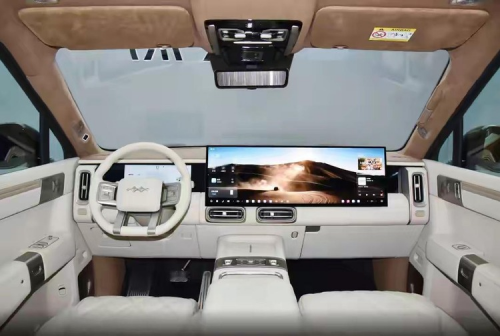
The interior is where Fangchengbao has spent its money. A 30-inch screen spans the centre stack and the passenger side, backed by a 12.3-inch instrument display, a 50-inch augmented-reality head-up display and a streaming rear-view mirror. A 6.6-inch detachable screen and a 21.4-inch roof-mounted display serve the back, and four BYD Pad expansion ports let owners add more. The brand calls the result a "5D cockpit" with up to ten connected screens.
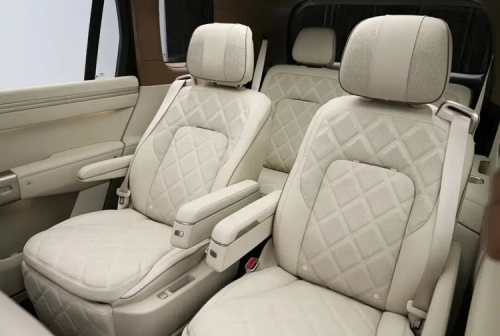
The seats are more interesting than the screens. The front passenger gets what Fangchengbao calls a cradle seat — it rocks gently, mimicking a rocking chair, a feature we have not seen on any other production SUV at this price. The second row is a pair of independent zero-gravity chairs with heating, ventilation, massage, electric leg rests, powered armrests and 140°-plus recline, plus a lateral sliding function that lets the two seats move together or apart. The third row gets the same heating, ventilation and massage treatment, its own air vents,cupholders and charging ports.
Six seats with no penalty seat
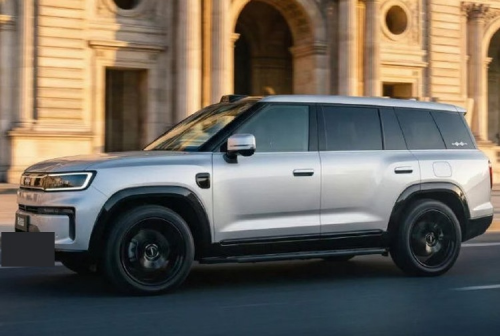
With a 3,130 mm wheelbase and a boxy silhouette, the packaging is unusually honest. Fangchengbao claims a 150°-plus recline in the rear and a fist of knee room behind a 175 cm adult. The boot holds 655 litres with all seats up, 1,245 litres with the third row folded, plus a 60-litre under-floor compartment. There are 59 storage points, an 11.3-litre double-door fridge, 31-speaker Devialet audio with headrest speakers in the first two rows, and a nano-aqueous-ion air system.
The hardware list reads like a price sheet two classes higher: rear-wheel steering at up to 7°, the Yunian-P hydraulic body control system with 75 mm of ride-height adjustment, a roof-mounted lidar feeding the God's Eye B driver-assistance suite, six-piston front calipers, and the nano-ceramic clearcoat used on the Yangwang U8. The tailgate is a split "sky-and-earth" design rated to 300 kg, opening and closing in five seconds and holding anywhere between 0° and 72°.
What buyers outside China should know
Nothing official has been said about export. Spanish-language coverage reports a late-2026 Chinese on-sale date and says European distribution is being evaluated, but not before 2028, with a speculative price of €80,000–100,000. Those figures are media estimates, not Fangchengbao guidance. What is concrete is the positioning: a 400,000-yuan car in China, which puts a right-hand-drive or export programme in the same bracket as a Toyota Land Cruiser or a Mercedes GLE once duties and homologation are added.
The Tai 9 also has to answer a question about its own brand. Fangchengbao has never sold a car at this price, and the cabin technology — however impressive on paper — will be judged against the Li L9 and the AITO M9, both of which have had years to refine software. The Tai 9 wins on hardware novelty. Whether it wins on the ownership experience is the open question.
Key facts
| Model | Tai 9 (2026, base trim) |
|---|---|
| Body type | 5-door, 6-seat SUV |
| L × W × H (mm) | 5270 × 1999 × 1850 |
| Wheelbase (mm) | 3130 |
| Track, front / rear (mm) | 1716 / 1730 |
| Approach / departure angle | 19° / 22° |
| Kerb weight (kg) | 2865 |
| Gross vehicle weight (kg) | 3495 |
| Towing capacity (kg) | 2000 |
| Engine | BYD472ZQB, 1.5T turbo L4, 1498 mL |
| Engine max power | 115 kW (net 110 kW) |
| Front motor | 200 kW |
| Rear motor | 200 kW |
| System output | 400 kW / 544 Ps |
| Battery | LFP (FinDreams cells), 66.48 kWh |
| WLTC electric range | 310 km |
| Combined range | 1,630 km |
| WLTC fuel use, charge-sustaining | 6.4 L/100 km |
| Drivetrain | Electric AWD |
| Top speed | 220 km/h |
| 0–100 km/h (s) | - |
| Transmission | - |
| Body structure | Unibody |
| Tyres | 255/50 R21 (opt. 255/45 R22 / 275/45 R22) |
| Boot volume | 655 L / 1,245 L / 60 L under-floor |
| Drag coefficient | - |
| Vehicle warranty | - |
| Emission standard | China VI |
| FOB price (USD) | 59,500 * |
Specifications as published on Autohome for the 2026 base trim. A dash means the manufacturer has not published a figure. * FOB is an estimate derived from the announced "400,000-yuan class" positioning; the official price has not been released.
FAQ
Short answer:
the Tai 9 is a 5,270 mm six-seat plug-in hybrid flagship with 310 km of electric range, 1,630 km combined, and a second row that out-features most luxury MPVs. It goes on sale in China after 15 November at a price Fangchengbao describes as "400,000-yuan class".
- When does the Fangchengbao Tai 9 go on sale?
Reservations opened on 27 October 2026; showroom cars arrived before the end of that month, and the launch is scheduled for after 15 November. - Is the Tai 9 a real off-roader?
- No. It uses a load-bearing body rather than a ladder frame, with 19°/22° approach and departure angles. It is a road-biased family SUV with off-road styling.
- How big is the Tai 9 compared with the Tai 7?
Considerably. The Tai 9 measures 5,270 × 1,999 × 1,850 mm on a 3,130 mm wheelbase; the Tai 7 is roughly 4.99 m long on a 2.92 m wheelbase. - Will the Tai 9 be exported?
Fangchengbao has not confirmed an export programme. Overseas reports point to a European decision not before 2028.